Memecoins: When a Joke Becomes a Multi-Billion Pound Asset Class
What actually separates a memecoin from any other cryptocurrency, and why the same structural risk shows up in every one of them, whatever the mascot.
By Firoz Khan|23 August 2026|Updated 11 October 2026|3 min read
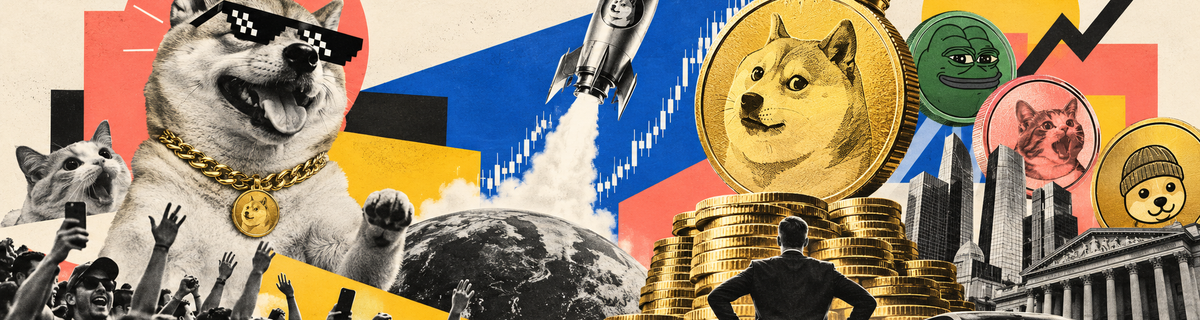
A memecoin is a cryptocurrency created primarily around a joke, meme or cultural reference rather than a specific technical purpose or product roadmap. Dogecoin popularised the category, and a huge wave of similarly-themed tokens has followed, with wildly varying degrees of longevity and, in the vast majority of cases, no underlying utility at all.
What actually drives a memecoin's price
Community size, social media momentum and cultural relevance drive memecoin valuations almost entirely, in the near-total absence of the fundamentals, revenue, usage, a defined problem being solved, that at least partially anchor the valuation of most other cryptoassets. That makes them some of the most sentiment-driven, and volatile, assets in the entire crypto market.
Why supply design deserves real scrutiny here
Many memecoins launch with an enormous total supply and heavy concentration in the founding team's or early insiders' wallets, which creates real risk of large, sudden sell-offs crashing the price for everyone who bought in later. Checking token distribution before buying matters more for memecoins than for almost any other category.
Say a token has a total supply of 1 billion, and ten wallets hold 60% of it, an average of 60 million tokens each. If one of those wallets sells a tenth of its holding, that is 6 million tokens hitting the market. If the token normally trades 20 million tokens a day, that single sale is 30% of a day's volume, which can move the price sharply. The numbers are invented to show the arithmetic, not a real token.
The rug pull risk specific to this category
Memecoins are launched constantly, often anonymously, with minimal or no development effort behind them beyond the initial hype push, making them a favoured vehicle for rug pulls, where creators abandon the project and cash out shortly after launch, sometimes within hours.
A realistic way to size any memecoin exposure
Treat any memecoin allocation as pure speculation on cultural momentum, sized as money you'd be entirely comfortable losing outright, and separate from whatever you might allocate to established cryptoassets with genuine underlying use cases. The category has produced some real, if largely unrepeatable, success stories, and a far larger number of total losses that don't make the headlines.
Newsletter
Make sense of money and crypto
Practical guides, useful calculators, and straightforward insights, delivered to your inbox.
Unsubscribe anytime. See our Privacy Policy.
What the UK rules say about promotion
Since 8 October 2023, firms marketing crypto to UK consumers, including overseas firms, have to follow the FCA's financial promotion rules. That means a clear risk warning, such as "Don't invest unless you're prepared to lose all the money you invest", a cooling-off period for first-time investors, and no incentives to invest, including refer-a-friend bonuses. A memecoin pitch that leaves out the warning or dangles a bonus is not following those rules.
The FCA also says crypto is largely unregulated in the UK, that it is highly unlikely you would be covered by the Financial Services Compensation Scheme, and that you should be prepared to lose all the money you put in. Memecoins are the category where that warning is most literal.
Checks to make before you buy
The FCA's guidance on crypto investment scams and its scam advice suggest a short sequence that applies directly to a memecoin pitch.
- Check the firm. If you cannot find it on the FCA's Financial Services Register, it is unlikely to have permission to offer you crypto products.
- Check the Warning List. It names firms the FCA believes operate without permission, but a firm not being on it does not make it safe, because firms change names.
- Beware clones. Fraudsters copy a real firm's name and details, so use only the phone number and email address shown on the Register, not the ones the firm gives you.
- Treat unsolicited contact, pressure to act quickly, returns that sound too good to be true and requests to install software or share your screen as red flags.
- Remember registration is not protection. Even a registered firm does not give you access to the Financial Services Compensation Scheme or the Financial Ombudsman if something goes wrong.
What a pump and dump looks like
A pump and dump is a coordinated effort to push a price up, usually on social media, so that the people who organised it can sell to people who arrive late. A memecoin with a small community, a large insider holding and anonymous founders fits that pattern. A token trending does not mean it is safe to buy. It often means the selling has already started.
Tax
Swapping one token for another is a disposal for Capital Gains Tax in the UK, and each type of token has its own pool. Someone who trades several memecoins in a month may create dozens of records, each needing a date, quantity and value in pounds. If a token becomes worthless, do not simply ignore it. HMRC's guidance refers to negligible value claims in some situations, so check it before assuming a loss can be claimed.
Where to read more
- Dogecoin and Cardano explained: the memecoin that started the category, next to a research-led chain
- FCA crypto guidance explained: the regulator's warnings in full
- Crypto whales explained: how large holders move thin markets
- Crypto taxes in the UK: records for many small trades
A reminder
The FCA risk warning still applies to higher-risk crypto content. Always assess how much risk you are willing to take before buying.
Related reading